
The Financial Calculator Playbook for Tech, Biotech, and Healthcare Professionals
Word count: 1,452 | Read time: 6 min
A good financial calculator turns a vague worry into a number you can act on. Can we afford that house? Are my RSUs a problem? How much of this bonus will I keep? For professionals in tech, biotech, and healthcare, those questions show up fast and carry real dollars, which is why Longitude Financial Planning built the six interactive calculators embedded below. Each one comes with a sample scenario, the inputs we used, and a plain-language read of what the output means.
Use them in any order, since each financial calculator stands on its own. Change the numbers to match your life, then download the companion Financial Calculator Worksheet to save your results. When a result raises a question the tool cannot answer, that is the point where a fiduciary planner earns their keep.
Your Employer Stock Risk
Your paycheck and your portfolio may depend on the same company. One bad quarter can hit both at once.
Start with this financial calculator if you hold RSUs, ESPP shares, or options. The RSU concentration calculator shows how much of your investable wealth rides on a single ticker, what a severe drop would cost, and what diversifying might cost in taxes. Making equity compensation simple starts with seeing the exposure clearly.
Take Elena, 38, a product director at an Austin software company. She holds $420,000 of vested company stock with a $250,000 cost basis, $680,000 in everything else, and $160,000 of RSUs vesting over the next year. The calculator puts her employer stock at 38.2% of investable assets, rising to 44.5% if she keeps her next vests. A 70% decline would erase $294,000, or 26.7% of her portfolio.
That stress test is not hypothetical. J.P. Morgan defines a catastrophic decline as a 70% fall from peak without recovery, and its 2024 study found healthcare and biotech produced the largest number of those decliners of any sector (J.P. Morgan). Many of them looked sound right before the fall.
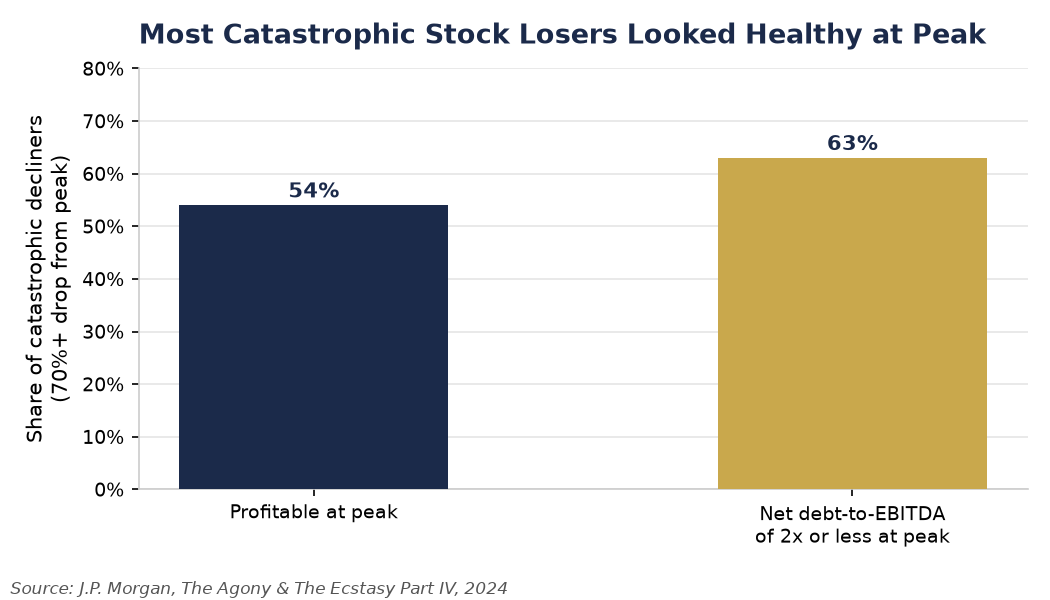
More than half of the stocks that later lost 70% or more were profitable when they peaked, so a healthy-looking employer is not a safety net.
The calculator also flags a withholding problem. RSUs count as ordinary income when they vest (IRS Publication 525), and employers commonly withhold federal tax at the 22% supplemental rate (IRS Publication 15). At Elena's 35% marginal rate, that gap could leave about $20,800 due in April. Selling $310,000 to reach a 10% concentration target would trigger an estimated $23,590 in tax at an assumed 18.8% capital gains rate, a cost worth spreading across tax years.
RSUs and Employer Stock
RSU and Employer Stock Concentration Calculator
See how much of your net worth rides on one company, and what diversifying might cost.
Simplified: treats all gains as long-term and ignores AMT, wash sales, blackout windows, and 10b5-1 plans. Federal supplemental withholding is 22% up to $1M. Built by Longitude Financial Planning, a fee-only fiduciary. Educational illustration only; not personalized advice.
Review my results with a plannerSample inputs for Elena; replace them with your own grant and portfolio numbers.
If your concentration result tops 20%, a free financial check-up can map a sell-down schedule around your vesting dates and blackout windows.
Retirement Savings and Withdrawals
Work-optional at 55 sounds close. The withdrawal rate changes the math.
Our retirement financial calculator works in two stages. It projects your savings to a target age in today's dollars, then tests how much income that balance can sustain over the number of years you expect to live off it.
Priya is a 34-year-old senior software engineer who wants work to be optional at 55. She has $210,000 saved and puts away $51,700 a year, combining her 401(k) deferral, employer match, and a brokerage contribution (the 2026 401(k) employee limit is $24,500, according to the IRS). At a 7% return and 3% inflation, the calculator projects about $2.1 million in today's dollars by 55.
That sounds like plenty. Priya wants $80,000 a year, though, and a retirement from 55 to 95 lasts 40 years. Morningstar's research puts the safe starting withdrawal rate at 3.9% for a 30-year retirement, 3.3% for 40 years, and 2.9% for 50 years (Morningstar).
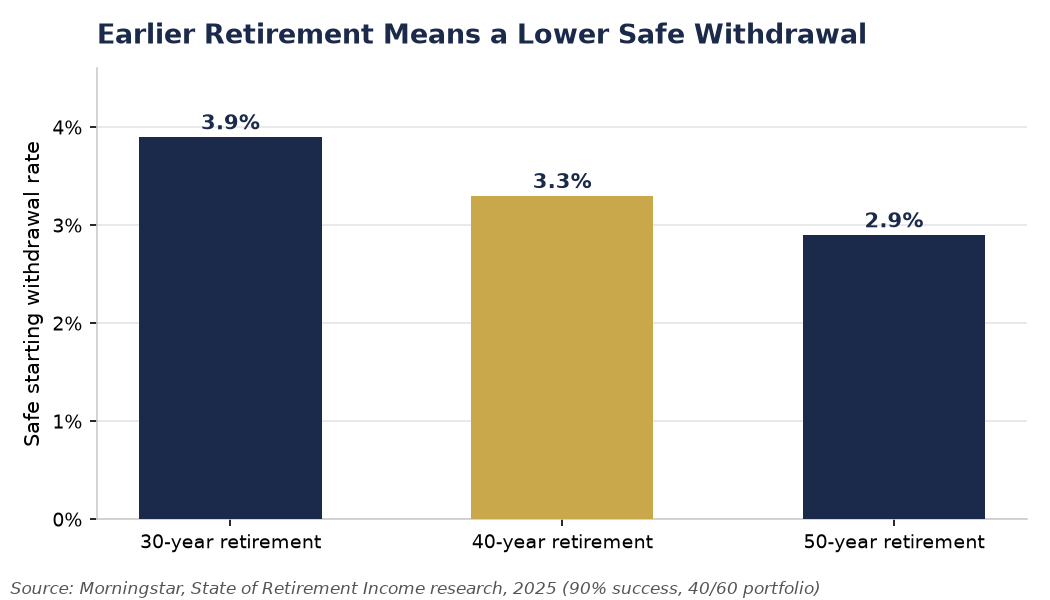
Every extra decade of retirement lowers the share of your portfolio you can safely spend each year.
At 3.3%, Priya needs about $2.42 million. She is 87% funded, roughly $325,000 short, and the calculator shows that about $10,300 more in annual savings closes the gap. Pushing the date to 57 or trimming the spending target works too. For simpler what-if growth math, our Time Value of Money Calculator solves for any missing piece: future value, payment, rate, or years.
Retirement Savings and Withdrawal
Retirement Savings and Withdrawal Calculator
Project your savings to a target age, then test how much income it can sustain.
Assumes constant returns, savings that rise with inflation, and no taxes. Auto withdrawal rate scales from 3.9% (30-year retirement) to 2.9% (50-year), based on Morningstar's 2025 research. Built by Longitude Financial Planning, a fee-only fiduciary. Educational illustration only; not personalized advice.
Review my results with a plannerWhat Extra Income Costs
A bonus feels like a raise. The IRS sees a new top bracket.
The tax impact calculator estimates 2026 federal income tax using the IRS 2026 brackets and standard deductions, then isolates the cost of one decision: an RSU vest, a bonus, a stock sale, or a Roth conversion.
Consider a married biotech couple, a research scientist and a regulatory affairs manager, with $310,000 in salaries, a $25,000 bonus, $60,000 of vested RSUs, and $49,000 of pre-tax 401(k) contributions. After the $32,200 standard deduction, taxable income lands at $313,800 and estimated federal tax at $60,508, an effective rate of 15.3%. The more useful number is the marginal one. A $40,000 Roth conversion would cost $9,600, a full 24%, and still stay below the 32% bracket that starts at $403,550 of taxable income.
That makes this a practical Roth conversion calculator for the years when income dips, such as a sabbatical or a gap between jobs. If you moved from California, run our 2026 California State Tax Calculator too, since income earned or property sold there can still create a state bill.
Tax Impact
2026 Federal Tax Impact Calculator
Estimate your 2026 federal income tax, then see what one more dollar of income costs.
Ordinary income only. Excludes FICA, NIIT, AMT, credits, capital gains rates, and phase-outs. Uses IRS 2026 brackets and standard deductions. Built by Longitude Financial Planning, a fee-only fiduciary. Educational illustration only; not personalized advice.
Review my results with a plannerGold bars show which brackets your extra income reaches.
Mortgage Affordability, Honestly
The bank's approval letter is a ceiling. Your budget deserves its own number.
Planning to buy a home starts with what a payment does to the rest of your life, not with the price on a listing. The mortgage affordability calculator applies the 28/36 guideline: housing at no more than 28% of gross income, and all debt payments at no more than 36%, a back-end standard echoed in the CFPB's debt-to-income worksheet.
Marcus is an ER nurse and Dana is a physician assistant, with $240,000 of combined income, $1,100 a month in car and student loan payments, and $90,000 for a down payment. At the 7.28% average 30-year rate reported by Freddie Mac on October 1, 2026, a 2% property tax rate, and $3,600 of annual insurance, the calculator caps their price near $695,000. The $5,600 monthly payment breaks into $4,141 of principal and interest, $1,159 of property tax, and $300 of insurance. Each 1% change in rate moves their price by roughly $45,500, so rate shopping matters as much as house hunting.
Mortgage Affordability
Mortgage Affordability Calculator
Translate income, debts, and today's rates into a home price your budget can carry.
Excludes PMI, closing costs, and maintenance. Default rate reflects Freddie Mac's 30-year average as of October 1, 2026. Built by Longitude Financial Planning, a fee-only fiduciary. Educational illustration only; not personalized advice.
Review my results with a plannerSample inputs for Marcus and Dana; shift-work income may need a longer track record for lenders.
Debt Payoff That Sticks
Minimum payments feel responsible. They can more than double what you pay in interest.
Jordan, 29, is a clinical research associate at a biotech firm carrying $14,000 on a credit card at 22.15%, the average rate on accounts assessed interest in the Federal Reserve's latest release. Add a $6,500 personal loan at 11% and $38,000 of student loans at 5.5%.
Paying only the minimums, the debt payoff calculator shows Jordan debt-free in six years and one month with $17,318 of interest. Adding $800 a month cuts that to three years. The avalanche method, highest rate first, costs $6,921 in interest. The snowball method, smallest balance first, costs $7,578. The $657 difference is small enough that Jordan should pick the method that keeps him motivated.
Debt Payoff
Debt Payoff Calculator: Avalanche vs Snowball
Compare payoff timelines and total interest across up to four debts.
Assumes fixed rates, no new charges, and freed-up minimums rolled into the next debt. Built by Longitude Financial Planning, a fee-only fiduciary. Educational illustration only; not personalized advice.
Review my results with a plannerSample inputs for Jordan; the calculator rolls each paid-off minimum into the next debt.
Cash Flow Comes First
Most money leaks happen in plain sight. A monthly view makes them visible.
Sam is a nurse practitioner and Riley is a QA engineer. They earn more than $150K combined but still feel broke, and the cash-flow planning calculator shows why. Of their $10,400 monthly take-home pay, $3,100 goes to rent, $1,650 to other fixed bills, $900 to debt, $3,900 to variable spending, and only $500 to automated savings. That leaves $350 unassigned and a savings rate of 8.2%.
Their $8,000 emergency fund covers 1.4 months of essential costs. Nationally, only 63% of adults would cover a $400 emergency with cash or its equivalent (Federal Reserve). By automating the $350 and redirecting 15% of variable spending, Sam and Riley lift their savings rate to 13.8% and reach a six-month cushion in about 19 months.
Cash-Flow Planning
Cash-Flow Planning Calculator
Find where take-home pay goes each month and what a small redirect can do.
Uses the monthly figures you enter. Irregular costs (travel, gifts, annual premiums) should be averaged into monthly amounts. Built by Longitude Financial Planning, a fee-only fiduciary. Educational illustration only; not personalized advice.
Review my results with a plannerSample inputs for Sam and Riley; average irregular costs like travel into monthly amounts.
Financial Calculators are Myopic
Every calculator gives one outcome in isolation. Your plan has to answer everything else.
Each financial calculator above isolates one decision, and real decisions overlap. An RSU sale like Elena's changes the tax cost of a Roth conversion like the biotech couple's. Marcus and Dana's down payment competes with their emergency fund. None of these tools model the alternative minimum tax on incentive stock options, PMI on a low down payment, Social Security timing, insurance gaps, or how a new baby rewrites a budget.
Calculators also assume steady returns and fixed rates. Real markets can hand you a bad year right after you retire, and the order of returns matters most in that window. A planner tests your numbers against those sequences, coordinates accounts across both spouses, and catches the trade-offs no single input field can show. Two more site tools help with that bigger picture: the Life Insurance Calculator for coverage needs and the Advisor Fee Comparison Calculator for what advice costs over 30 years. You can find every tool on the Longitude calculators page.
Bring your financial calculator results to a free consultation, and we will connect them into a single plan. Longitude Financial Planning is a fee-only fiduciary, so our review of your RSU, retirement, mortgage, or tax numbers comes with no product to sell. Download the worksheet, run your numbers, and let us turn them into decisions.
Longitude Financial Planning is a fee-only registered investment adviser dedicated to fiduciary advice for the households we serve. This article and its calculators are provided for educational purposes and reflect our perspective as of the date of publication; they are not personalized investment, tax, or legal advice. Tax laws, regulations, interest rates, and market conditions change, and the strategies discussed may not be appropriate for every reader. We encourage you to consult a qualified professional, ideally one held to a fiduciary standard, before acting on any information here.
