
What Triggers the IRMAA Surcharge and How to Reduce or Appeal
Word count: 1,445 | Read time: 6 min
Most people assume Medicare is a flat monthly premium that everyone pays equally. It is not. If your household income in retirement exceeds a certain threshold, you pay more (sometimes significantly more) for the same coverage. The Income-Related Monthly Adjustment Amount, known as IRMAA, adds a surcharge on top of standard Medicare Part B and Part D premiums for higher-income enrollees. For dual-income couples who spent their working years earning well and saving aggressively, IRMAA is one of the most common financial surprises in the first year of Medicare enrollment. Planning for it is straightforward. Discovering it unprepared is expensive.
The Two-Year Lookback That Blindsides New Retirees
Medicare uses income you reported two years ago. Your retirement date and your IRMAA date are not the same date.
IRMAA is calculated from your Modified Adjusted Gross Income as reported on your federal tax return two years prior to the Medicare enrollment year. When you enroll in Medicare at 65 in 2026, CMS uses your 2024 tax return to determine your surcharge tier. If your last full year of employment was 2024 and you earned $400,000 that year, you owe IRMAA on your 2026 Medicare premiums. Even if your 2025 and 2026 income has been substantially lower in retirement.
Per Centers for Medicare and Medicaid Services guidance, MAGI for IRMAA purposes is defined as Adjusted Gross Income plus any tax-exempt interest income reported on Line 2a of Form 1040. This definition catches two types of income that some high earners assume will be sheltered: municipal bond interest and, indirectly, any income that reduces AGI through above-the-line deductions but does not eliminate MAGI. Roth IRA withdrawals (which are neither taxable nor included in AGI) are not counted in IRMAA MAGI, which is one of the reasons Roth conversion planning has outsized value for couples approaching Medicare age.
What the Surcharge Actually Costs
At the top IRMAA tier, a couple pays more than $12,000 per year in Medicare surcharges alone. The first tier still adds over $2,000 annually.
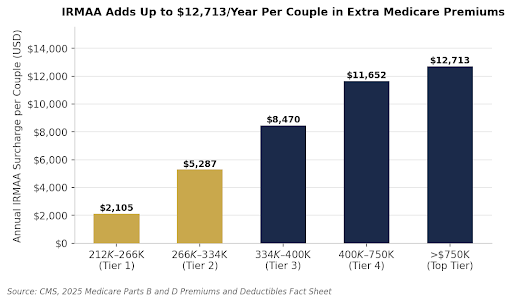
The IRMAA surcharge for a married couple ranges from $2,105 per year at the first tier to $12,713 per year at the top tier — a cost that persists year after year and is determined entirely by income from two years prior.
The 2025 IRMAA thresholds for married filing jointly taxpayers begin at $212,000 in MAGI. The 2026 thresholds rise slightly, with the first bracket starting at approximately $218,000, consistent with the annual inflation adjustments CMS applies per Medicare's published premium schedule. Five income tiers exist above the standard premium, with the highest bracket applying to couples with MAGI above $750,000. According to CMS data, approximately 8% of Medicare enrollees pay IRMAA. That figure is weighted heavily toward the professional couples most likely to be reading this.
The Part B standard premium in 2025 is $185 per month per person, or $2,220 per year for a couple. At the first IRMAA tier, the surcharge adds $70.00 per person per month, increasing total Part B premiums by $1,680 per year for a couple. At the highest tier, the total Part B premium rises to $628.90 per person per month. The Part D IRMAA adds an additional $13.70 to $76.40 per person per month depending on the tier. Combined, the top-tier couple pays over $12,700 per year more than a standard-premium enrollee for identical Medicare coverage.
The Income Sources That Trigger IRMAA
IRMAA MAGI is a specific definition. Some income you might expect to shelter counts; some you might expect to trigger it does not.
Understanding which income sources count toward IRMAA MAGI is the first step in managing it. Traditional IRA and 401(k) distributions are fully counted — they add directly to AGI, which flows into MAGI. Taxable capital gains are counted. Dividends and interest are counted. Social Security benefits are counted at up to 85% once other income exceeds provisional income thresholds. Required minimum distributions, which begin at age 73 under current IRS rules, are fully counted and often come in large amounts if the account has grown significantly during decades of accumulation.
Roth IRA qualified distributions are not counted, because qualified Roth withdrawals are excluded from gross income entirely. HSA distributions used for qualified medical expenses are not counted. Returns of basis from taxable accounts are not counted — only the gain portion of a sale is included in AGI. Municipal bond interest is specifically added back into MAGI under the IRMAA definition, which eliminates one tax-sheltering strategy that some near-Medicare retirees assume will help.
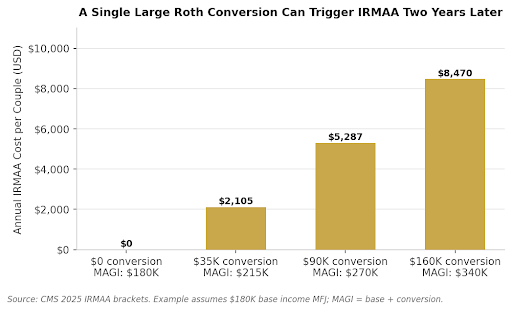
A $35,000 Roth conversion added to a $180,000 MAGI base stays below the first IRMAA tier; larger conversions of $90,000 or $160,000 push into higher tiers two years later, illustrating the importance of conversion sequencing in the years approaching Medicare enrollment.
How to Reduce or Appeal Your IRMAA
IRMAA is not always final. Life changes, a specific appeal form, and forward planning all offer real options.
If your income has dropped significantly in the two years since the tax return CMS is using, you can appeal the determination using SSA Form SSA-44. The Social Security Administration administers IRMAA on behalf of CMS, and the form allows enrollees to request a reduced surcharge based on a life-changing event. The eight qualifying events are: marriage, divorce or annulment, death of a spouse, work reduction, work stoppage, loss of income-producing property through no fault of your own, loss of pension income, and employer settlement payment that has since ended.
For early retirees who left employment in the last two years, work stoppage is the most commonly applicable qualifying event. The appeal requires documentation of the income change and a current income estimate. If approved, SSA will calculate IRMAA based on the more recent income rather than the two-year-old tax return. The appeal is worth filing whenever the income drop is large enough to move you to a lower tier — the annual savings compound across multiple Medicare enrollment years.
For planning purposes, the most powerful IRMAA reduction strategy is managing income in the two years before Medicare enrollment. A couple enrolling in Medicare at 65 in 2031 is being assessed based on their 2029 tax return. The 2029 return is the one that matters — which means income decisions in 2029 have a direct, quantifiable cost in 2031 Medicare premiums.
Coordinating Roth Conversions With IRMAA
The conversion that saves you $20,000 in lifetime income tax can cost you $5,000 per year in Medicare surcharges if timed carelessly.
Roth conversions are one of the most powerful tools in the early retirement tax planning arsenal, but they add directly to MAGI in the year converted. A couple doing $100,000 in Roth conversions on top of $150,000 in other retirement income pushes MAGI to $250,000 — above the first IRMAA threshold for 2026. If those conversions occur two years before Medicare enrollment, the resulting IRMAA surcharge could cost $2,100 or more per year for two consecutive Medicare enrollment years.
The practical implication is that Roth conversion strategy should be coordinated with the Medicare enrollment timeline. Aggressive conversions are often most efficient in the early years of retirement, when income is low and marginal tax rates are favorable. As Medicare enrollment approaches, the conversion pace should be modeled against the IRMAA thresholds. Converting $50,000 in each of two years may produce a better tax outcome than converting $100,000 in a single year — not because the total tax cost differs much, but because staying below the IRMAA threshold in the critical two-year lookback window avoids the surcharge entirely.
HSA accounts funded during working years offer a clean supplement: qualified medical expense distributions are not included in MAGI, and the triple tax advantage makes them uniquely efficient for healthcare costs in retirement, including Medicare premiums in some circumstances per IRS Publication 969.
Couples who spent their 40s building wealth in high-income careers tend to arrive at Medicare with large pre-tax accounts, significant deferred capital gains, and income that genuinely needs active management to minimize IRMAA exposure. The planning is not complicated, but it requires starting the IRMAA-specific projection two to three years before Medicare enrollment — not the week you receive your first Medicare card.
If you are approaching Medicare age or planning a retirement strategy that will play out near Medicare eligibility, we help couples model the IRMAA exposure and build the conversion and withdrawal plan around it. The surcharge is predictable and, in many cases, reducible with enough lead time.
Longitude Financial Planning is a fee-only registered investment adviser dedicated to fiduciary advice for the households we serve. This article is provided for educational purposes and reflects our perspective as of the date of publication; it is not personalized investment, tax, or legal advice. Tax laws, regulations, and market conditions change, and the strategies discussed may not be appropriate for every reader. We encourage you to consult a qualified professional, ideally one held to a fiduciary standard, before acting on any information here.
