
What a Fee-Only Fiduciary Financial Advisor Actually Does and Why It Matters for Tech and Healthcare Professionals
Word count: 1,736 | Read time: 7 min
A fee-only fiduciary financial advisor should do more than recommend investments. For a software engineer balancing salary, RSUs, stock options, and tax exposure, or a healthcare professional coordinating retirement plans, Social Security, Medicare, and a final working paycheck, the real work is integration. Each decision changes the others.
“Fee-only” and “fiduciary” describe two different protections. One addresses compensation. The other addresses the standard of conduct within the agreed advisory relationship. Together, they can create a strong foundation for advice, but labels alone are not enough. The SEC notes that an adviser’s obligations depend partly on the scope of services the adviser agreed to provide (SEC Commission Interpretation). That makes the engagement agreement, regulatory disclosures, planning process, and actual answers to your questions more important than a professional title.
Fee-Only Fiduciary Financial Advisor Test
A polished professional title proves surprisingly little. Written answers reveal the relationship you are actually buying.
Start with a direct request: “Will you and your firm act as a fiduciary whenever you provide investment advice under this engagement?” Ask for the answer in writing. Then ask whether any part of the relationship involves brokerage, product sales, insurance compensation, or another non-advisory role. The SEC describes an investment adviser’s federal fiduciary duty as duties of care and loyalty across the agreed relationship (SEC Commission Interpretation).
Next, define the perimeter. Does the advice cover only accounts managed by the firm, or also your 401(k), 403(b), 457(b), IRAs, HSA, employer stock, cash, debt, insurance, tax planning, and retirement-income choices? Is the work a one-time plan or an ongoing relationship with monitoring? The SEC recognizes both limited and ongoing advisory arrangements, which means fiduciary status does not automatically make every topic part of the engagement (SEC Commission Interpretation).
Turn to compensation with one broad question: “Who pays you, your firm, or any related party?” The answer should cover client fees, commissions, referral payments, revenue sharing, insurance compensation, and product-level payments. Ask for first-year and ongoing costs in dollars and percentages, separated from fund, platform, custody, and transaction expenses. The SEC advises investors to compare transaction and ongoing fees because those costs reduce the money left to compound (Investor.gov).
Ask how the advisor’s pricing could influence recommendations. An asset-based fee can create an incentive to retain managed assets when you consider a mortgage payoff, real estate purchase, annuity, or workplace-plan rollover. Flat pricing can create different tensions around workload and service limits. SEC staff identifies commissions, asset-based compensation, engagement fees, third-party payments, and account recommendations among potential sources of conflicts (SEC Staff Bulletin).
Relevant competence deserves evidence, not initials after a name. Ask the fee-only fiduciary financial advisor to walk through a decision similar to yours. A technology professional might ask what the advisor reviews before an option exercise. A clinician nearing retirement might ask how multiple plans, Social Security, Medicare exposure, and taxable savings will be modeled together. Request a redacted sample plan or action list. A strong candidate explains assumptions, tradeoffs, specialist coordination, implementation ownership, and update triggers.
Finish the advisor evaluation questions by asking for Form ADV Part 2, the adviser’s brochure supplement when applicable, and Form CRS when the firm is required to provide one. Form ADV contains information about an advisory firm’s business, fees, conflicts, and disciplinary history (Investor.gov). Independently check the firm and individual through Investor.gov’s Investment Adviser Public Disclosure tools and FINRA BrokerCheck when relevant (Investor.gov).
Your final test should be plain language. Can everyone in the household explain what you will pay, what you will receive, who owns each decision, and which conflicts remain? A capable non-CFP fee-only fiduciary financial advisor can pass through fiduciary commitment, relevant experience, documented process, candid disclosure, and clear communication. No designation substitutes for those qualities.
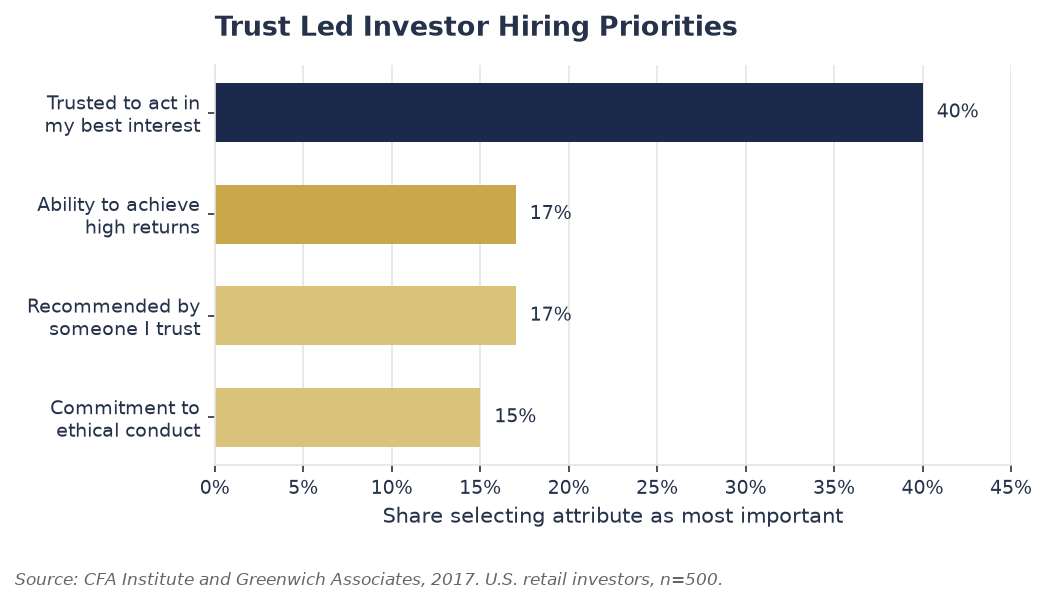
In this 2017 survey of U.S. retail investors with at least $100,000 of investable assets, trust to act in the investor’s best interest ranked well above return potential (CFA Institute).
A 2017 CFA Institute and Greenwich Associates survey of 500 U.S. retail investors age 25 or older with at least $100,000 in investable assets found that 40% chose “trusted to act in my best interest” as the most important hiring attribute. Seventeen percent chose high returns, another 17% chose a trusted recommendation, and 15% chose ethical conduct (CFA Institute). Trust still requires verifiable behavior.
Fee-Only And Fiduciary
Commission-free advice removes one powerful incentive. Other financial conflicts still deserve full daylight.
Fee-only is a compensation description. Under NAPFA’s published standard, a fee-only adviser is paid by clients, while neither the adviser nor a related party receives compensation contingent on a financial-product purchase or sale (NAPFA). A fee-only fiduciary financial advisor may charge hourly, flat, retainer, subscription, or asset-based fees (NAPFA). Fee-based commonly describes arrangements combining client fees with commissions, though actual disclosures matter more than the label (NAPFA).
Fiduciary describes conduct. The SEC states that an investment adviser must serve the client’s best interest, seek to avoid subordinating the client’s interest to its own, and eliminate a conflict or provide full and fair disclosure so the client can give informed consent (SEC Commission Interpretation). The duty is meaningful, but it operates within the relationship’s agreed scope.
This is why “conflict-free” is too broad. A no-commission financial advisor removes product-sales compensation, but asset-based pricing, flat fees, service limits, rollover recommendations, and related parties can still create conflicts. SEC staff states that all financial professionals have at least some conflicts that must be identified and addressed (SEC Staff Bulletin). Fee only financial planning is strongest when remaining incentives are visible and managed.
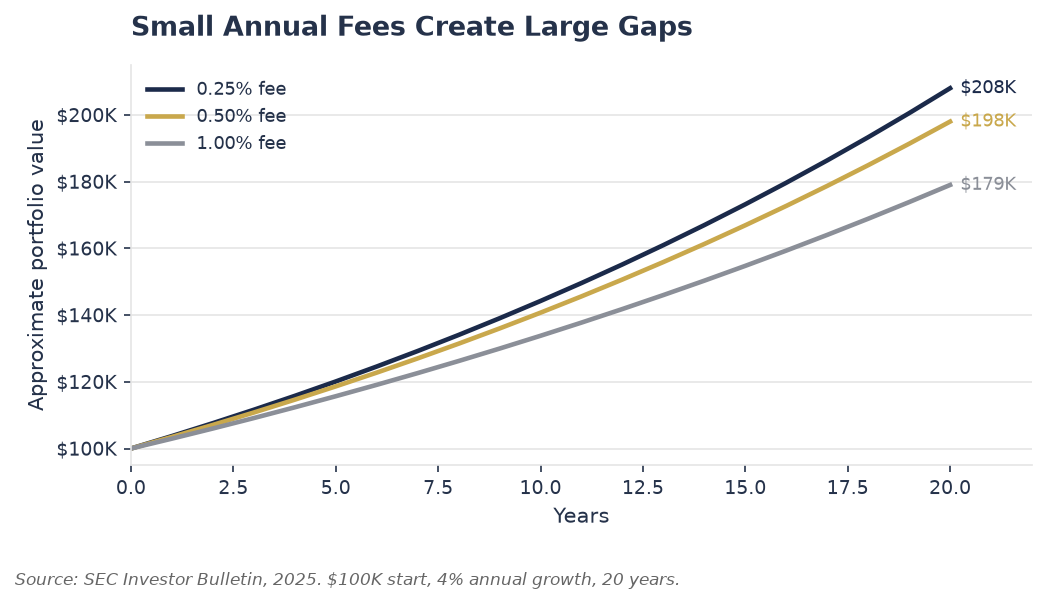
The SEC illustration isolates the effect of fees; it does not measure the value or quality of the service received (Investor.gov).
Fees also deserve context. In an SEC hypothetical, $100,000 growing at 4% annually for 20 years reaches approximately $208,000 with a 0.25% annual fee, $198,000 with a 0.50% fee, and $179,000 with a 1.00% fee (Investor.gov). The nearly $30,000 gap between the lowest and highest fee scenarios does not prove that the cheapest advisor is best. It proves that cost, scope, competence, and value should be evaluated together.
Planning In Real Life
Your career creates complexity faster than separate accounts can reveal it.
Consider a mid-career software engineer whose compensation includes salary, a bonus, RSUs, an employee stock purchase plan, and incentive stock options. A comprehensive financial planning process begins with one inventory of grants, vesting dates, exercise windows, withholding, cost basis, trading restrictions, and employer-stock concentration. It then connects those details to cash reserves, retirement contributions, debt, and upcoming purchases.
The tax treatment cannot be assumed from the word “stock.” The IRS distinguishes statutory options, including incentive stock options and employee stock purchase plan options, from nonstatutory options. An ISO exercise can create alternative minimum tax consequences, while many nonstatutory options create compensation income at exercise (IRS). A fee-only fiduciary financial advisor should make equity compensation simple enough for the client to see the calendar, assumptions, and specialist handoffs.
Now consider a healthcare professional several years from retirement. A fee-only fiduciary financial advisor providing financial planning for doctors, nurses, and other clinicians should not assume identical benefits. The advisor first inventories each 401(k), 403(b), 457(b), pension, IRA, HSA, taxable account, deferred-compensation benefit, and insurance policy. The plan then models retirement dates, spending, Social Security, pension elections, withdrawals, Roth conversions, required distributions, healthcare costs, and Medicare income-related premiums.
Timing matters across these systems. Social Security explains that claiming before full retirement age reduces the monthly benefit, while delaying beyond full retirement age increases it up to age 70 (Social Security Administration). Medicare income-related adjustments generally use tax-return information from two years before the premium year, subject to procedures for updated information and certain life-changing events (Social Security Administration). A retirement-readiness analysis should show how these moving parts interact rather than optimize one account in isolation.
From Complexity To Plan
Complexity becomes manageable once every decision shares one calendar.
The following anonymized composite illustrates a planning process. It is not a testimonial, does not describe a specific client, and does not promise an outcome.
A dual-income couple came to planning with salaries, bonuses, RSUs, stock options, several workplace plans, IRAs, an HSA, cash, and a concentrated employer-stock position. One partner worked in technology. The other worked in healthcare and was considering retirement within several years. They had capable tax and investment professionals, but no shared map connecting vesting dates, estimated taxes, benefit elections, retirement timing, portfolio risk, and household goals.
The fee-only fiduciary financial advisor began with discovery rather than a product recommendation. The couple organized tax returns, grant documents, benefits, account statements, insurance, estate documents, spending, and goals. The advisor then built one decision calendar covering vesting dates, taxes, retirement contributions, concentration limits, benefit choices, Medicare milestones, and account cleanup.
The practical outcome was coordination. Each action had an owner, due date, assumption, and reason. The couple could see which decisions required a CPA, which required employer-plan information, and which they could execute themselves. Ongoing reviews focused on what had changed in compensation, taxes, retirement timing, spending, and markets. This is the value of an integrated process: fewer isolated decisions, clearer tradeoffs, and a documented basis for the next move.
What Transparency Looks Like
Transparency should feel concrete before your first recommendation arrives.
A transparent relationship starts with a household-specific fee estimate, written scope, service calendar, implementation responsibilities, and understandable conflicts. It continues with documented assumptions, prioritized actions, progress reporting, and explanations when recommendations change. Form CRS, when required, summarizes services, fees, costs, conflicts, standards of conduct, and disciplinary history for retail investors (SEC).
That standard applies whether someone is seeking a financial advisor for young professionals, targeted financial coaching, or full-service wealth management. The correct service level should reflect the work required. A client who needs cash-flow systems and accountability may not need the same engagement as a household coordinating equity compensation, retirement-income planning, investments, and multiple outside professionals.
Longitude Financial Planning describes itself as providing fee-only fiduciary advice for professionals in tech, biotech, and healthcare. Its current website states that the firm never accepts sales commissions from its recommendations and presents a service path that includes Financial Coaching, Wealth Management Essentials, Wealth Management Complete, and Investment Management. The coaching service emphasizes guided wealth building, while the wealth management tiers provide full-service support for increasing levels of complexity, including employer stock and retirement decisions (Longitude Financial Planning).
That structure lets a relationship match present needs rather than force every household into one package. Prospective clients should still review the current agreement, Form ADV, applicable relationship summary, fee schedule, and scope. A fee-only fiduciary financial advisor earns trust by making the relationship understandable before asking the client to act.
If employer stock, retirement benefits, taxes, and multiple accounts have turned separate decisions into one complicated system, a fiduciary planning review can help you define the work, identify the tradeoffs, and build a coordinated action calendar. Longitude offers service levels ranging from financial coaching to full-service wealth management, with no sales commissions on its recommendations.
Longitude Financial Planning is a fee-only registered investment adviser dedicated to fiduciary advice for the households we serve. This article is provided for educational purposes and reflects our perspective as of the date of publication; it is not personalized investment, tax, or legal advice. Tax laws, regulations, and market conditions change, and the strategies discussed may not be appropriate for every reader. We encourage you to consult a qualified professional, ideally one held to a fiduciary standard, before acting on any information here.
