
Word count: 1,244 | Read time: 5 min
If you have RSUs vesting this year, appreciated stock, or a home sale on the horizon, the capital gains tax conversation is not as simple as looking up a rate and multiplying. The actual tax bill depends on how long you have held the asset, what your combined household income looks like, and whether a surcharge you may not know about applies on top of the headline rate. For dual-income couples in tech, healthcare, or any field where equity compensation is part of the picture, getting clear on these mechanics before a sale is worth more than any single investment decision.
The 23.8% Rate
Most people believe the top capital gains rate is 20%. For most dual-income couples, it is not.
The federal long-term capital gains rates are 0%, 15%, and 20%, which is what most people know. What fewer people factor in is the Net Investment Income Tax, a 3.8% Medicare surtax that stacks on top of those rates for households above certain income thresholds. For married couples filing jointly, the NIIT applies when Modified Adjusted Gross Income exceeds $250,000, per the IRS. That threshold has never been adjusted for inflation since it was set in 2012, which means it captures more households every year without any change to the law.
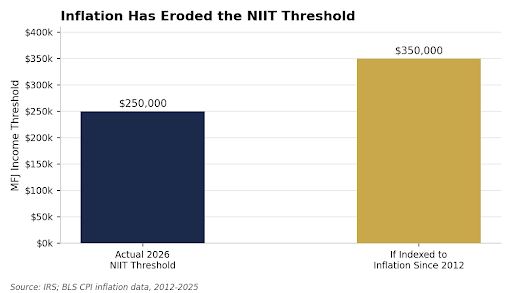
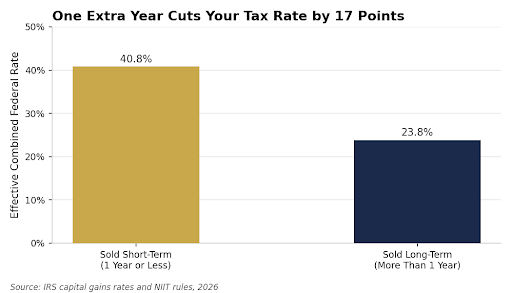
The practical effect: a couple with combined income above $250,000 who sells appreciated stock or receives a large RSU distribution does not pay 20% on long-term capital gains. They pay 23.8%. On short-term gains, which are taxed as ordinary income, a couple in the 37% bracket faces a combined federal rate of up to 40.8%. Neither of those numbers appears on the standard rate table most articles reference.
This is not a reason to panic. It is a reason to plan around the thresholds rather than treating a sale as a binary decision.
Short Versus Long Term
One year separates a 37% tax rate from a 20% one. The calendar is doing active work on your behalf whether you realize it or not.
Short-term capital gains apply to assets held for one year or less. They are taxed at your ordinary income rate, just like a paycheck. For a high-earning couple in the 37% bracket, selling stock three days before a year has passed costs nearly twice as much in federal tax as waiting until the anniversary date, per NerdWallet. That 17-percentage-point gap between the 37% ordinary rate and the 20% long-term rate is one of the largest arbitrages available in the tax code.
Long-term capital gains apply when you have held an asset for more than one year. The rates are 0%, 15%, and 20%, depending on your taxable income, and they apply to the gain only, not to the cost basis you already paid tax on. For most high-earning couples, the relevant question is not whether they face the 15% or 20% rate, but whether the NIIT surtax also applies, which brings the effective top rate to 23.8%.
The holding period for RSU shares begins on the vesting date, not the grant date. If your shares vest in March and you want long-term treatment, you need to hold until at least April of the following year before selling.
The 2026 Tax Brackets
The bracket numbers matter more for capital gains than for ordinary income. Knowing exactly where you land can change the timing decision entirely.
For married couples filing jointly in 2026, the 0% long-term capital gains rate applies to taxable income up to $98,900, per Kiplinger. The 15% rate applies from there up to $613,700. The 20% rate applies above $613,700. These thresholds increased modestly from 2025, giving high earners a small additional window at the lower rates.
The 0% bracket is worth knowing even for high-income households. If you have a year with unusually low income, a job transition period, or a planned sabbatical, long-term gains realized in that window may be partially or fully tax-free at the federal level. This kind of timing flexibility is something most families have at least once in a decade if they are looking for it.
One important note: these brackets apply to taxable income, not gross income. The standard deduction ($30,000 for married couples filing jointly in 2026) and other deductions reduce the number that actually determines your rate. A couple with $280,000 in gross income may have a lower taxable income than the raw number suggests, which can affect which bracket applies to capital gains.
Where RSUs Fit In
Restricted stock units are taxed twice. Most people plan only for the first hit, which is the more predictable one.
When RSUs vest, the shares are treated as ordinary income at their market value on that date. Your employer withholds taxes, typically at the 22% federal supplemental rate. For most high-earning tech and healthcare professionals, that 22% withholding is not enough. If your total compensation places you in the 32%, 35%, or 37% federal bracket, the gap between what was withheld and what you actually owe shows up as a tax bill in April, per Mercer Advisors.
The second tax event happens when you sell the shares. At that point, capital gains rules apply on the difference between what you sell for and the price at vesting (your cost basis). If you sell immediately on the vesting date, the gain is essentially zero. If you hold for more than a year, any appreciation is taxed at long-term capital gains rates rather than ordinary income rates. That creates a genuine decision: sell now and eliminate concentration risk, or hold for long-term treatment and accept market risk in the meantime.
There is no universally right answer. But the decision should be made deliberately, not by default. Many people hold RSU shares without a clear plan, which often leads to concentrated positions that expose a significant portion of household net worth to a single stock.
Planning Moves For 2026
The best capital gains planning happens before the sale. A decision made on the right side of a threshold can save thousands.
A few practical moves are worth reviewing before the end of the year. The first is checking whether your MAGI will exceed $250,000 jointly. If you are close to that line, shifting some income-producing activity (like a Roth conversion or a large sale) to a year when other income is lower can keep you below the NIIT threshold.
Tax-loss harvesting is the second lever. If you have positions sitting at a loss in a taxable account, selling them before year-end generates losses that offset capital gains dollar for dollar. A realized loss on one position can reduce the tax cost of selling an appreciated RSU lot in the same year.
If you plan to donate to charity, contributing appreciated shares directly to a donor-advised fund avoids capital gains entirely on the donated amount. You get the full fair market value as a deduction without paying tax on the gain. This is particularly useful in a high-income vesting year.
Finally, if you have multiple RSU lots from different vesting dates, you have some control over which shares you sell first. Selling the lot with the highest cost basis minimizes the taxable gain on a given sale. Most brokerage platforms allow you to select which tax lot to sell rather than defaulting to FIFO (first in, first out).
Capital gains planning does not need to be stressful. It requires attention to timing, thresholds, and the difference between acting before and after a holding period ends.
Longitude Financial Planning is a fee-only registered investment adviser dedicated to fiduciary advice for the households we serve. This article is provided for educational purposes and reflects our perspective as of the date of publication; it is not personalized investment, tax, or legal advice. Tax laws, regulations, and market conditions change, and the strategies discussed may not be appropriate for every reader. We encourage you to consult a qualified professional, ideally one held to a fiduciary standard, before acting on any information here.
