
529 Plans Just Got More Powerful: What Texas Families Should Do Now
Word count: 1,761 | Read time: 7 min
If you have children or plan to, there has never been a better year to open a 529 plan. Two recent federal laws, the SECURE 2.0 Act and the One Big Beautiful Bill Act signed in July 2025, have transformed these accounts from straightforward college savings vehicles into something far more flexible. Texas families now have one of the most powerful tools available for funding education from kindergarten through a career. The problem is that most families wait too long, or skip the conversation entirely. According to the Investment Company Institute, more than 17 million American families save through 529 plans today, yet BestColleges reports that more than half of all parents are still unaware the accounts exist, and the average balance covers only a fraction of actual college costs. If that describes where you are, this is the place to start.
What Changed
The 529 plan you have, or have not yet opened, is now a different tool than it was even two years ago.
The One Big Beautiful Bill Act, signed in July 2025, made two changes that every Texas family with children should know. First, the annual withdrawal limit for K-12 expenses doubled from $10,000 to $20,000 per student per year beginning in 2026. That alone is meaningful for families paying private school tuition anywhere in Texas. But the expansion of what those dollars can actually buy matters just as much. Under the new law, qualified K-12 expenses now include curriculum and instructional materials, textbooks, tutoring provided outside the home, fees for standardized tests including AP exams and the SAT, and educational therapies for students with disabilities. Before 2025, only tuition counted.
The second change is broader. One financial expert told CNBC that the OBBBA effectively turned 529 plans into "lifelong education savings accounts." Starting in 2025, you can withdraw from a 529 tax-free to pay for career credentialing programs, professional certification and licensing fees, continuing education required to maintain a license, and workforce training programs authorized under the federal Workforce Innovation and Opportunity Act. A nurse renewing her license, an engineer earning a new professional designation, or a parent re-entering the workforce through a trade program can now use 529 funds for expenses that were never qualified before. One important caveat from CNBC's reporting: not every online certificate or AI bootcamp qualifies. Programs must meet federal workforce standards or recognized national credentialing requirements, so verify before withdrawing.
The SECURE 2.0 Act added a different kind of safety valve, effective for rollovers beginning January 1, 2024. If a 529 account has been open for at least 15 years, the beneficiary can now roll unused funds into a Roth IRA, up to $7,000 per year and a $35,000 lifetime maximum. Contributions and their earnings from the last five years are excluded from eligible rollover funds, and the Roth IRA must be in the beneficiary's name. The income limits that normally restrict Roth IRA contributions do not apply here. Per Kitces, this effectively lets families treat a 529 as a dual-purpose vehicle: college savings with a built-in retirement backstop if plans change.
What a 529 Plan is
Most people know 529 plans exist. Far fewer understand how they actually work.
A 529 plan is a tax-advantaged savings account created by Congress in 1996 under Section 529 of the Internal Revenue Code. The account is owned by an adult, typically a parent or grandparent, and names a beneficiary who is expected to use the funds for education. There are no income limits to open one, no IRS-set annual contribution limits (though gift tax rules apply, covered below), and contributions are not deductible on your federal taxes. What you get instead is tax-free growth and tax-free withdrawals when the money is spent on qualified expenses.
One child can have multiple 529 accounts from different account owners. Grandparents, aunts, uncles, and family friends can each open their own account naming the same child as beneficiary. The beneficiary can also be changed at any time to another qualifying family member if the original beneficiary receives a scholarship, changes direction, or does not use the funds. That flexibility is one reason 529 plans work well across a wide range of family situations, from a couple expecting their first child to high-earning parents who already have teenagers and want to accelerate contributions before vesting events or bonus seasons.
What 529 Pays For
The list of qualified expenses is longer than most families realize. It expanded meaningfully in 2025.
At the college level, qualified expenses include tuition and required fees at accredited two- and four-year institutions, room and board for students enrolled at least half-time (limited to the school's official cost-of-attendance allowance for off-campus housing), books, supplies, and computers or software used primarily for schoolwork, per the IRS. Qualifying schools include vocational institutions and community colleges, not just four-year universities.
For K-12, the 2026 federal limit is $20,000 per year and now covers tuition along with the expanded list of curriculum materials, tutoring, and standardized test fees described above. State conformity with the new federal rules varies, so it is worth confirming Texas has adopted the expanded definitions before withdrawing for newly eligible K-12 items.
Student loan repayment is also a qualified use, up to $10,000 per beneficiary and $10,000 per sibling over a lifetime, per the original SECURE Act. For younger beneficiaries, that provision alone makes the account worth opening early since the funds can cover debt after graduation even if scholarships reduce the need for college withdrawals. And as of 2025, career and credentialing expenses round out the qualified list.
Non-qualified withdrawals trigger ordinary income tax plus a 10% federal penalty on the earnings portion only, not the original contribution. If a child receives a scholarship, you can withdraw up to the scholarship amount penalty-free, though income tax on the earnings still applies. And after 15 years under SECURE 2.0, unused balances have a path to the beneficiary's Roth IRA rather than a taxable withdrawal.
The Tax Math in Texas
Texas has no state income tax. That changes one thing about the 529 deduction, but not the federal advantage.
Because Texas does not impose a state income tax, contributions to a Texas 529 plan do not generate a state tax deduction. That is different from states like New York or Virginia, where residents can deduct contributions from state taxable income each year. For Texans, the federal tax benefits carry the full weight of the value proposition, and they are substantial.
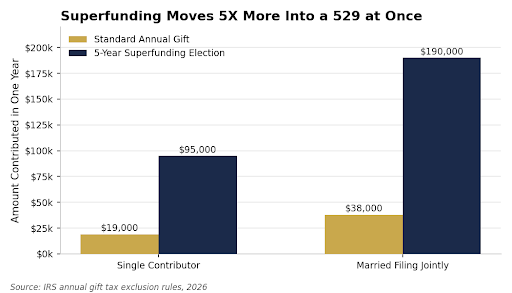
Growth inside a 529 is completely federal-tax-free, and withdrawals for qualified expenses avoid both federal and state tax. Over 18 years of consistent contributions, that compounding advantage accumulates in a way that after-tax brokerage accounts simply cannot match. On the gift tax side, each contributor can give up to $19,000 per beneficiary in 2026 without filing a gift tax return or using any of the lifetime exemption, per Saving for College. Married couples contributing jointly can give $38,000 per child per year.
For families who want to move a larger sum in one year, the IRS allows superfunding: a five-year gift tax election that lets a single contributor put in up to $95,000 at once, or $190,000 per child for a married couple filing jointly. The funds are treated as spread across five tax years for gift tax purposes. You must file IRS Form 709 to elect this treatment even though no tax is due, and additional tax-free gifts to the same beneficiary are not permitted for five years after superfunding. For high-income households with a vesting event, bonus, or concentrated equity position creating a liquidity opportunity, superfunding a 529 can be an efficient way to move funds out of a taxable estate and into a tax-sheltered account for the next generation.
The maximum aggregate balance allowed across all Texas-sponsored 529 plans for a single beneficiary is $500,000, per Saving for College's state-by-state contribution limits data.
Choosing Your Texas Plan
Texas offers three 529 options. The differences between them matter more than most families expect.
The Texas College Savings Plan is the state's direct-sold option. Families open it online and choose from a range of actively and passively managed investment portfolios. Annual fees run well under 1% per year, per SmartAsset, and the account can be used at accredited schools nationwide. Age-based portfolios, which automatically shift toward more conservative allocations as the beneficiary approaches college age, are available for families who prefer a hands-off approach.
The LoneStar 529 Plan is sold exclusively through licensed financial advisors. It offers a different investment lineup built around institutional fund managers and suits families who want professional portfolio guidance built into the relationship. Fees are higher than the direct-sold plan.
The Texas Tuition Promise Fund is a prepaid plan that locks in today's tuition rates at Texas public colleges and universities. It covers tuition and required fees only, not room and board, books, or other expenses, per the Texas Tuition Promise Fund. It eliminates investment risk but also eliminates investment growth and restricts use to Texas public institutions. For families who want maximum flexibility and the broadest use of recent law changes, the Texas College Savings Plan is the more versatile choice.
Alternatives Worth Considering
A 529 plan is the right starting point for most Texas families. A few situations call for a different tool.
The Coverdell Education Savings Account allows a similarly broad range of qualified expenses but caps contributions at $2,000 per year per beneficiary and phases out entirely for joint filers earning more than $220,000, per Saving for College. Funds must be used by age 30. Most high-earning Texas households are ineligible.
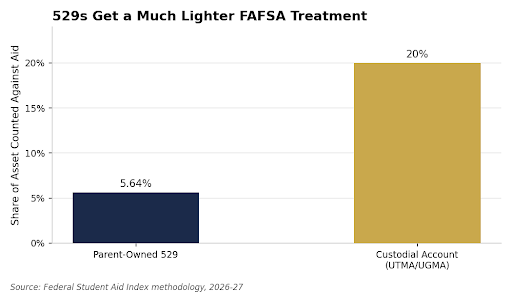
UTMA and UGMA custodial accounts carry no contribution limits, no spending restrictions, and no income thresholds. The tradeoff is financial aid impact: custodial account assets are assessed at roughly four times the rate of a parent-owned 529 under FAFSA, per Charles Schwab. For families targeting need-based aid, the 529 wins on that dimension by a wide margin.
A Roth IRA can technically serve as an education savings vehicle since contributions can be withdrawn at any time without tax or penalty, and earnings withdrawn for qualified education expenses avoid the 10% early-withdrawal penalty. But contributions are capped at $7,000 in 2026, and income limits phase out for joint filers above $236,000. For most high-earning families, the Roth IRA is better preserved for retirement, with the 529 handling education.
The families who benefit most from starting a 529 plan today are not necessarily those with the most money to put in. They are the ones who give compounding the most time to work.
If you have children, the best time to open a 529 plan was when they were born. The second-best time is now.
Longitude Financial Planning is a fee-only registered investment adviser dedicated to fiduciary advice for the households we serve. This article is provided for educational purposes and reflects our perspective as of the date of publication; it is not personalized investment, tax, or legal advice. Tax laws, regulations, and market conditions change, and the strategies discussed may not be appropriate for every reader. We encourage you to consult a qualified professional, ideally one held to a fiduciary standard, before acting on any information here.
