
Health Savings Account: The Triple Tax Benefit Most People Are Missing
Word count: 1,251 | Read time: 5 min
If you have a high-deductible health plan through your employer and you are not contributing to a Health Savings Account, you are leaving one of the most powerful tools in the tax code sitting on the table. The HSA is the only account that gives you a tax break going in, tax-free growth while the money sits invested, and tax-free withdrawals when you spend it on qualified medical expenses. No 401(k) or Roth IRA does all three at once. Yet only about 13% of HSA account holders actually invest the funds, according to Devenir Research, meaning the vast majority are using a sophisticated financial vehicle as a simple checking account for copays.
The Triple Tax Math
Three tax breaks in one account is not typical.
Here is how the math works. When you contribute to an HSA, the money comes out of your paycheck before federal income tax, state income tax, and FICA taxes (Social Security and Medicare combined) are calculated. For someone in the 22% federal bracket, a $4,400 individual contribution saves roughly $970 in federal income tax alone, before counting state taxes or FICA. That is money you never gave to the government in the first place.
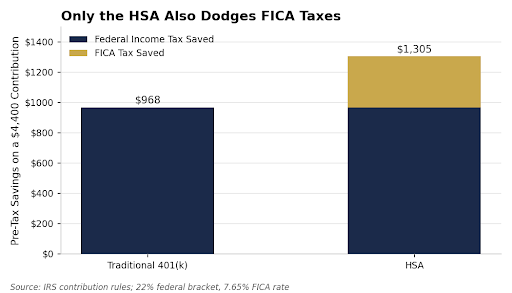
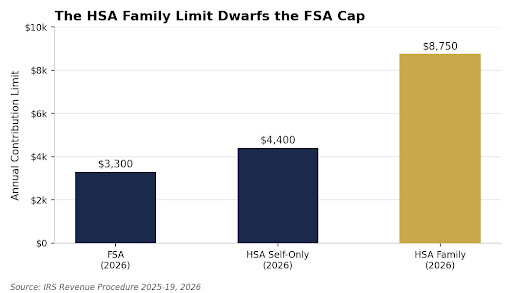
Inside the account, the money grows completely tax-free. Dividends, interest, capital gains: none of it is taxed as long as it stays in the HSA. And when you spend the money on a qualified medical expense, the withdrawal is also tax-free. The IRS sets 2026 contribution limits at $4,400 for individuals with self-only high-deductible health plan coverage and $8,750 for families. If you are 55 or older, you can add an extra $1,000 per year as a catch-up contribution.
To put that in context: a family that maxes out their HSA every year from age 30 to 65 and invests the funds, rather than spending them on current healthcare, could accumulate a substantial pool of tax-free medical dollars by retirement. The average retired couple at 65 will need roughly $345,000 in after-tax savings just to cover healthcare costs in retirement, per Morgan Stanley. The HSA is built precisely for that.
What is an HSA
Most people think of an HSA as a healthcare spending account. The ones who use it well think of it differently.
An HSA is a personal savings account available only to people enrolled in an HSA-eligible High-Deductible Health Plan. You own the account. It stays with you if you change jobs, switch employers, or leave the workforce entirely. Your employer may contribute to it, which is free money on top of your own contributions. There are no use-it-or-lose-it rules: unlike a Flexible Spending Account, unused funds roll over every year indefinitely.
To qualify for an HSA in 2026, your HDHP must have a minimum annual deductible of at least $1,700 for self-only coverage or $3,400 for a family plan, and your out-of-pocket maximum cannot exceed $8,500 for individuals or $17,000 for families, per IRS Revenue Procedure 2025-19. You cannot contribute to an HSA if you are enrolled in Medicare, are a dependent on someone else's tax return, or have a second health plan that is not HSA-eligible.
The account is administered through a bank or investment firm. Many employers automatically open one when you enroll in an HDHP. Once your balance exceeds a threshold (often $1,000 or $2,000 depending on the provider), most platforms let you invest the rest in mutual funds, ETFs, or index funds.
What Qualifies as an Expense
The IRS list of qualified expenses is longer than most people expect.
Qualified medical expenses include doctor visits, prescription drugs, dental and vision care, mental health services, and a wide range of over-the-counter items including pain relievers, allergy medication, and menstrual care products. The CARES Act of 2020 permanently reinstated OTC drugs as qualified without a prescription. Long-term care insurance premiums qualify up to IRS-set limits. COBRA premiums during a job transition qualify. Medicare Part B, Part D, and Medicare Advantage premiums qualify once you reach 65.
What does not qualify: gym memberships, cosmetic procedures, nutritional supplements without a diagnosis, and general health and wellness purchases not tied to a specific medical condition. Non-qualified withdrawals before age 65 trigger ordinary income tax plus a 20% penalty on the amount withdrawn, significantly worse than the 10% penalty on early 401(k) withdrawals. After 65, the penalty disappears and non-qualified withdrawals are simply taxed as ordinary income, making the HSA behave exactly like a traditional IRA.
One strategy worth knowing: you do not have to reimburse yourself immediately. The IRS does not impose a deadline for reimbursing yourself for qualified expenses. That means you can pay a medical bill out of pocket today, save the receipt, invest your HSA funds for years, and reimburse yourself tax-free later after the money has grown. Fidelity notes this as one of the most underutilized aspects of HSA planning.
HSA Versus FSA
These two accounts share three letters and almost nothing else.
The Flexible Spending Account and the Health Savings Account are often confused, but they work very differently. An FSA is employer-owned, which means if you leave your job, you typically lose unused funds. FSAs have a use-it-or-lose-it structure. Most plans require you to spend the balance by the end of the plan year, though some allow a small rollover (up to $660 in 2025) or a grace period.
HSAs have none of those restrictions. The money is yours, it rolls over every year, and it can be invested. FSAs cannot be invested; they sit as cash. The 2026 FSA contribution limit is $3,300, lower than the HSA family limit of $8,750. You also cannot contribute to both an HSA and a standard Health FSA in the same year, though a Limited Purpose FSA (covering only dental and vision) is compatible with an HSA.
For someone with a qualifying HDHP, the HSA is almost always the superior vehicle. The FSA makes more sense for people whose health plan does not qualify for an HSA, or who have predictable, near-term medical expenses they want to pay with pre-tax dollars and prefer not to manage an investment account.
Your HSA at Retirement
The money you save on copays today could be your most valuable tax-free asset at 65.
Here is the strategy that high-earning couples consistently underuse: Rather than spending HSA funds on current medical expenses, invest them and pay healthcare costs out of pocket while you are still earning. Save every receipt. At retirement, you can reimburse yourself for years of accumulated medical expenses all at once, completely tax-free, while the invested balance has compounded for decades.
After 65, the HSA becomes even more flexible. You can use it for Medicare premiums, dental, vision, and virtually any healthcare cost in retirement. For non-medical withdrawals, it behaves like a traditional IRA: you pay ordinary income tax, but no penalty. This makes the HSA a genuine third retirement account alongside your 401(k) and Roth IRA, with a significant edge in that medical withdrawals are never taxed at all.
Only about 13% of HSA owners currently invest their funds, per Devenir Research. If you are in that other 87%, even moving half your HSA balance into a low-cost index fund is a step forward. The contribution limits reset every January. The best time to start treating your HSA as an investment account was years ago. The second-best time is when you open your benefits enrollment window this fall.
If you are not sure whether your current health plan qualifies, or whether an HDHP actually makes sense given your family's healthcare usage, that is exactly the kind of question worth running through your financial plan before open enrollment closes.
Longitude Financial Planning is a fee-only registered investment adviser dedicated to fiduciary advice for the households we serve. This article is provided for educational purposes and reflects our perspective as of the date of publication; it is not personalized investment, tax, or legal advice. Tax laws, regulations, and market conditions change, and the strategies discussed may not be appropriate for every reader. We encourage you to consult a qualified professional, ideally one held to a fiduciary standard, before acting on any information here
