
Is Social Security Taxable? What Most Retirees Learn Too Late
Word count: 1,220 | Read time: 5 min
A lot of people head into retirement expecting their Social Security check to arrive tax-free. For most, some of it is taxable. The amount depends on a formula the IRS has been using since 1983 that most people have never heard of. The thresholds in that formula have never been adjusted for inflation, which means the number of retirees caught by it grows quietly every year. Knowing how it works before you retire gives you options. Finding out after the fact usually just means a bigger tax bill.
The Provisional Income Formula
Most people assume their Social Security arrives tax-free. For most retirees, it does not.
The IRS uses a concept called provisional income to determine how much of your Social Security benefit is subject to federal income tax. The formula is: your adjusted gross income, not counting Social Security, plus any tax-exempt interest (such as municipal bond interest), plus 50% of your annual benefit. That total is your provisional income number.
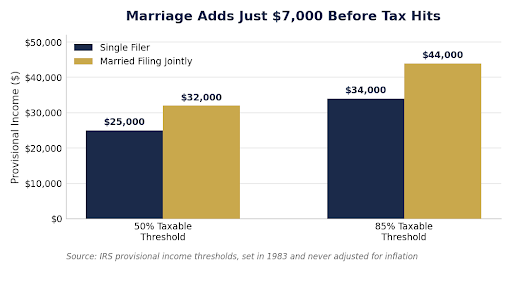
Once you have that number, you compare it against the taxation thresholds. For single filers, if provisional income is below $25,000, none of your Social Security benefit is taxable. Between $25,000 and $34,000, up to 50% of your benefit can be included in taxable income. Above $34,000, up to 85% of your benefit is taxable. For married couples filing jointly, the bands are $32,000 and $44,000, per the IRS.
The 85% ceiling is important: no matter how high your income, the maximum portion of Social Security that can be taxed is 85%. The other 15% is always tax-free. But for most retired couples with a pension, investment income, or IRA distributions alongside their benefits, the 85% band is where they land, per SmartAsset.
A quick example: a married couple with $30,000 in IRA withdrawals, $5,000 in interest income, and $40,000 in combined Social Security benefits has provisional income of $55,000 ($30,000 + $5,000 + $20,000). That puts them well above the $44,000 married threshold, meaning up to 85% of those benefits, or $34,000, is added to taxable income. At a 22% marginal rate, that is an extra $7,480 in federal taxes.
The Frozen Thresholds
The thresholds that determine Social Security taxation have not changed since 1983. Every year they stay frozen, more retirees cross them.
When Congress set the provisional income thresholds in 1983, a married couple with $44,000 in combined income was genuinely upper-middle class. That figure was designed to protect most retirees from taxation while capturing only higher-income households. It was never indexed for inflation.
Four decades of inflation have made $44,000 a modest retirement income in most parts of the country, yet it still sits above the threshold where 85% of benefits become taxable. The practical effect is that a far larger share of retirees pays tax on their benefits than Congress originally intended, simply because wages, savings, and investment returns have grown while the thresholds have not. This is sometimes called bracket creep without the bracket.
According to T. Rowe Price, the share of Social Security recipients owing federal tax on their benefits has grown significantly over the decades precisely because of this frozen threshold problem. For anyone doing retirement income planning today, the assumption should be that Social Security will be partially taxable, not that it will be tax-free.
The IRMAA Trap
Social Security taxation and Medicare surcharges come from the same place. Managing one without accounting for the other is a common and costly mistake.
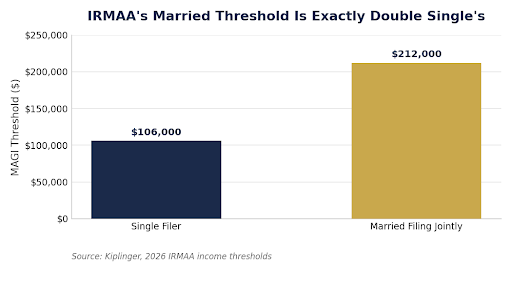
Provisional income is not the only number that matters for high-earning retirees. The Income-Related Monthly Adjustment Amount, known as IRMAA, adds a surcharge to Medicare Part B and Part D premiums for households above certain income thresholds. For 2026, single filers with MAGI above $106,000 and married couples above $212,000 face additional Medicare premium costs, per Kiplinger. The surcharges are tiered and can add several thousand dollars per year in Medicare costs for couples with moderate retirement income.
IRMAA is calculated based on your tax return from two years prior, which means decisions you make at 63 affect your Medicare costs at 65. A large Roth conversion, a property sale, or a year with heavy IRA withdrawals can push you into a higher IRMAA tier in a future year without you realizing it until the bill arrives.
The connection to this problem is straightforward: both problems are driven by the same input, your modified adjusted gross income. Managing retirement income thoughtfully, with an eye on both provisional income thresholds and IRMAA tiers, often means structuring withdrawals from multiple account types to keep total income below the relevant thresholds rather than drawing from a single source without coordination.
How To Reduce Exposure
Provisional income is made of parts. Changing the mix before you claim can shift how much of your benefit gets taxed.
The most effective lever most retirees have is the source of their income, not the amount. Withdrawals from a Roth IRA do not count toward provisional income. They are not included in adjusted gross income, they do not appear on your tax return as income, and they do not push you into a higher provisional income band. A retiree who draws from a Roth account instead of a traditional IRA can take the same amount of spending money home while reporting a lower provisional income number, potentially keeping more of their benefit tax-free.
This is why Roth conversions in the years before Social Security claiming are so valuable. Converting traditional IRA funds to Roth during the window between retirement and age 70 pays tax now at the current rate, reducing the pre-tax IRA balance that will generate taxable RMDs later. Smaller RMDs mean lower provisional income when Social Security arrives, which can mean a lower percentage of benefits subject to tax for the rest of retirement.
Qualified Charitable Distributions offer a second lever for those 70.5 and older. A QCD allows you to direct up to $111,000 per person directly from an IRA to a qualified charity in 2026. The distribution satisfies your Required Minimum Distribution but does not appear as income on your return, reducing AGI and therefore provisional income. For charitably inclined retirees, this is one of the most tax-efficient moves available.
The Planning Window
The years between retirement and Social Security claiming are often the most valuable in a person's entire financial life.
Most people retire in their early to mid-60s and delay claiming Social Security until 67, 68, or 70 to maximize their monthly benefit. That gap, often five to ten years, is a period when income is relatively controllable and tax rates may be at their lowest lifetime level. Earned income has stopped. Social Security has not started. Required minimum distributions may not have begun yet. The tax brackets are available to fill at modest rates.
This is the window for strategic Roth conversions, for filling the 12% and 22% brackets deliberately, and for positioning retirement income to minimize both Social Security taxation and future IRMAA exposure. A couple who converts aggressively and thoughtfully during this window can arrive at Social Security claiming with a lower provisional income profile for the rest of their lives.
The planning question is not just when to claim Social Security. It is what your income looks like in the years before you do, and whether you have used that window well.
Longitude Financial Planning is a fee-only registered investment adviser dedicated to fiduciary advice for the households we serve. This article is provided for educational purposes and reflects our perspective as of the date of publication; it is not personalized investment, tax, or legal advice. Tax laws, regulations, and market conditions change, and the strategies discussed may not be appropriate for every reader. We encourage you to consult a qualified professional, ideally one held to a fiduciary standard, before acting on any information here.
