
High Yield Savings Accounts in 2026: Account Basics and Why Traditional Savings Accounts Can’t Compete
Word count: 1,191 | Read time: 5 min
If your savings are sitting in a big bank, you're probably earning around 0.38% APY, roughly the national average according to the FDIC. The best high-yield savings accounts right now pay between 4% and 5%. On a $20,000 balance, that difference is roughly $800 a year in interest you're leaving on the table. The switch takes about ten minutes and carries no risk. Most people just haven't done it.
The Rate Gap Right Now
The difference between where your savings are and where they could be isn't small. It compounds every month.
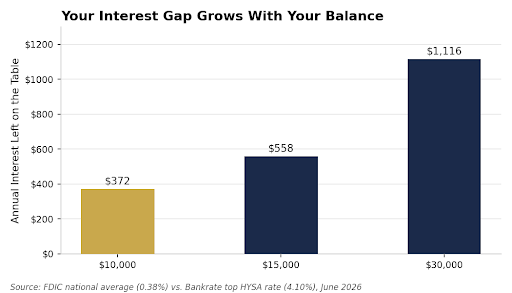
As of June 2026, the top high-yield savings accounts are paying up to 5.00% APY, per Fortune. The FDIC national average for traditional savings accounts sits at 0.38%. That means the best accounts are earning more than ten times what a standard bank savings account pays. For someone keeping a $15,000 emergency fund, which is roughly three to six months of expenses for many households, the difference between 0.38% and 4.10% comes out to about $560 a year.
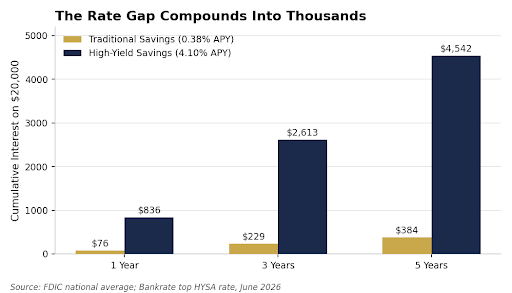
Rates have come down from the peak levels seen in 2023 and 2024, when some accounts briefly crossed 5.5%. But even at current levels, a high-yield savings account is meaningfully better than what most major banks are offering their existing customers. Bankrate tracks leading accounts at 4.10% APY as of this month. The math is straightforward: money that sits idle in a 0.38% account is quietly falling behind inflation while its owner waits for a better moment to act.
Why Online Banks Pay More
Online banks didn't invent a magic way to generate yield. They just got rid of the buildings.
The reason traditional brick-and-mortar banks pay low rates on savings accounts is pretty simple. A bank with hundreds of physical locations is paying for real estate, tellers, branch managers, and local marketing in every city it operates. Those costs have to come from somewhere, and one place they come from is the interest that doesn't get paid to depositors. Online banks and fintech-driven savings platforms have stripped that overhead away. No branches means no rent. No tellers means lower staffing costs. The cost savings get passed back to customers in the form of a higher annual percentage yield, per American Express.
This business model isn't complicated, nor is it new. It has been running at scale for more than a decade. The accounts work exactly like a traditional savings account: you deposit money, it earns interest daily and the interest is credited monthly, and you can transfer money out when you need it. The main functional difference is that you manage everything online or through an app rather than walking into a branch. For most people who already pay bills, transfer money, and check balances on a phone, that isn't much of a trade-off.
FDIC insurance applies the same way it does at any member bank, covering up to $250,000 per depositor per institution. The money is safe. The account is just more efficient.
Who Actually Opens These Accounts
High-yield savings accounts aren't a tool for sophisticated investors. They are available for anyone who banks online.
One of the quiet reasons people don't open a high-yield savings account sooner is the assumption that it's something more complicated than it is, or that it's aimed at a different kind of person. It isn't.
The majority of people opening these accounts are ordinary savers who decided their existing bank wasn't working hard enough for them. They are people in their 20s and 30s who opened their first account at a major bank because their parents banked there, and eventually compared rates and made a switch. They are couples building a down payment fund who wanted their savings to grow while they waited. They are small business owners keeping operating reserves somewhere that actually returns something.
There is no minimum status required to open a high-yield savings account. Most major platforms, including Ally, Marcus by Goldman Sachs, and SoFi, require no minimum balance to open and charge no monthly fees. The process is entirely online, typically takes under fifteen minutes, and results in an account that immediately begins earning at the higher rate. The people who have done this aren't doing anything unusual. They are simply doing something most people in their financial circle have quietly already done.
Where Your Cash Belongs
A high-yield savings account isn't an investment. It's the best place to keep money that needs to stay liquid.
The right mental model for a high-yield savings account isn't an "investment alternative." It's "the account your short-term money should already be in." Cash you expect to need within one to three years doesn't belong in the stock market, where a downturn in the wrong month creates real problems. It belongs somewhere safe, accessible, and earning as much as it reasonably can without taking on risk. That is exactly what a high-yield savings account is designed to do.
The most common use cases are an emergency fund (three to six months of essential expenses), a house down payment fund, a car replacement fund, a tax reserve for self-employed earners, or any other pool of money you are accumulating for a near-term goal. All of these benefit from a higher rate while the money waits to be deployed. None of them benefit from being in a traditional savings account at 0.38%.
One practical consideration: some high-yield savings accounts limit the number of transfers or withdrawals you can make per month, which is a holdover from pre-2020 federal regulations. Most accounts have relaxed or eliminated this restriction, but it is worth checking before you open one if frequent access is important to you.
For money beyond what you need liquid, the conversation shifts to investing. A high-yield savings account isn't the right home for money you won't touch for five or more years. That money belongs in a diversified investment portfolio where it has time to grow in ways a savings account cannot match. The goal is to hold the right amount in each place: enough in the HYSA to cover real emergencies and near-term goals, and everything beyond that put to work more aggressively.
Getting Started
The only thing that separates your money from a better rate is an account you haven't opened yet.
The practical steps are short. Compare current rates at a few reputable aggregators like Bankrate or NerdWallet, both of which maintain updated rankings. Look for an account that is FDIC insured, has no monthly fees, requires no minimum balance (or one you can comfortably meet), and offers a rate that is competitive with the current top tier. Open it online, link your existing checking account, and transfer whatever you want to move.
If you have an emergency fund sitting in a checking account or a traditional savings account right now, moving it is the single easiest improvement available to your finances. No new strategy required. No risk involved. Just money doing more work in the same category it was already in.
Longitude Financial Planning is a fee-only registered investment adviser dedicated to fiduciary advice for the households we serve. This article is provided for educational purposes and reflects our perspective as of the date of publication; it is not personalized investment, tax, or legal advice. Tax laws, regulations, and market conditions change, and the strategies discussed may not be appropriate for every reader. We encourage you to consult a qualified professional, ideally one held to a fiduciary standard, before acting on any information here.
