
Financial Planning for Newly Married Couples
Word count: 1,622 | Read time: 7 min
Engaged couples spend a year planning a single day and never spend an hour planning the next fifty years. The conflict this can cause is the reason financial planning for newly married couples matters more than anything on a registry. The average American wedding cost $34,000 in 2025 according to The Knot's 2026 Real Weddings Study, and almost all of it buys one afternoon. Meanwhile, a third of partnered Americans say money is a source of conflict in their relationship, and among partnered adults 18 to 24 the number climbs to nearly half, per an Ipsos poll conducted for BMO. Preventing divorce by stopping money fights starts earlier than most couples expect. It starts in the weeks right after the wedding, while the paperwork is still open and no bad habits have set.
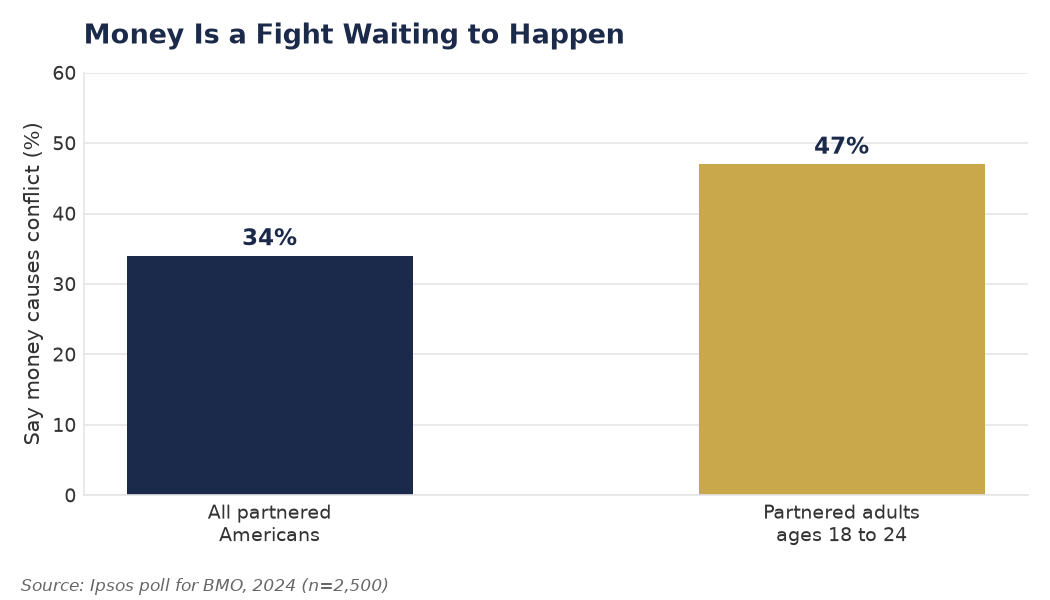
Money conflict is not rare, and it is most common among the youngest couples, the ones who have had the least time to build any shared system.
Your First Ninety Days
Regulations start a clock on your wedding day.
Three deadlines run at once and almost nobody knows about them ahead of time. The IRS instructs newly married employees to give their employer a revised Form W-4 within 10 days, because two incomes stacked together can push a household into a higher bracket or trigger the Additional Medicare Tax (IRS). Health coverage runs on two separate clocks: you have 30 days from the marriage to request special enrollment in an employer plan under HIPAA, and 60 days to pick a plan through the Marketplace (U.S. Department of Labor, HealthCare.gov). Miss the employer window and you may be locked out until open enrollment, since a Section 125 cafeteria plan is permitted to allow a mid-year election change but is never required to, and changes for marriage apply prospectively only (26 CFR 1.125-4).
The name change matters too. The name on your tax return has to match the name on file with Social Security or your refund can be delayed, which means Form SS-5 belongs on the list alongside the marriage certificate (IRS, Social Security Administration).
Dont forget about retirement accounts. Your will does not control your 401(k). The beneficiary form does. In Kennedy v. Plan Administrator for DuPont, the Supreme Court held unanimously that a plan administrator "did its ERISA duty by paying the benefits to Liv in conformity with the plan documents," even though the couple had divorced years earlier and she had waived her interest in the decree (Justia). The participant filled out the form in 1974, divorced in 1994, never updated it, and his ex-wife received the account instead of his daughter. Federal law also requires written spousal consent, witnessed by a plan representative or a notary, before a participant in a plan subject to the survivor annuity rules can name someone other than a spouse (26 U.S.C. 417). Pull up every 401(k), IRA, HSA, and life insurance policy either of you owns and update the forms. That is one afternoon of work protecting the largest asset most young households have.
What Marriage Changes
You did not change jobs. Your tax return changed anyway.
Your marital status on December 31 governs the whole year, so a December wedding rewrites a full twelve months of tax treatment (IRS). For 2026 the standard deduction is $32,200 filing jointly against $16,100 filing separately, and joint brackets sit at exactly twice the single thresholds through the 35% bracket (IRS). For a household earning $60,000 to $150,000 the rate schedule itself is close to neutral. The real swings come from credits, phaseouts, and repayment formulas. Couples with similar incomes tend to face a marriage penalty while couples with very different incomes tend to get a marriage bonus, and the Tax Foundation puts the extremes as high as 20% of income in bonuses and 12% in penalties.
Two changes are worth acting on immediately. A spousal IRA lets the lower earning or non-earning partner contribute up to $7,500 in 2026 on a joint return, which is often the fastest way to double retirement savings capacity in a one-income household (IRS).
Student loan repayment can change too. Filing jointly means the Department of Education generally uses your combined income to set an income-driven payment, and filing separately generally uses yours alone. Loans first disbursed on or after July 1, 2026 can use only the Repayment Assistance Plan, and every borrower still on PAYE or ICR has to choose a new plan by July 1, 2028 (Federal Student Aid). Newlywed money decisions and tax filing decisions are the same decision here, and running the return both ways is the only honest way to see it.
Two myths to debunk. Combining finances with a spouse does not combine credit scores, because scores are always calculated on an individual's own history, though a joint account will show up on both files (Consumer Financial Protection Bureau). And in Texas, community property covers anything either spouse acquires during the marriage regardless of whose name is on the account, while property owned before the wedding, gifts, and inheritances stay separate (Tex. Fam. Code 3.002, 3.001). Titling and record keeping matter more here than they do in most states.
Where Newlywed Money Goes
Small leaks in year one become six figures by retirement.
Start with liquidity, because it is the difference between a bad month and a new balance on a credit card. Only 47% of Americans say they could cover a $1,000 emergency expense (Bankrate), and the Federal Reserve found 12% of adults could not cover a $400 expense by any means at all, with 55% holding three months of expenses set aside (Federal Reserve). The cost of getting that wrong is unusually high right now. Credit cards assessed interest carried an average rate of 22.15% in the second quarter of 2026 (Federal Reserve G.19).
Next, free money. Participation in workplace retirement plans reached a record 86% of eligible employees and the average employer match hit a record 4.7% of pay (Vanguard). Plenty of workers still leave part of it behind. A widely cited 2015 Financial Engines study of 4.4 million participants found one in four missed some of the full match, giving up an average of $1,336 a year, roughly an extra 2.4% of income (SHRM). That study is a decade old, and it is still the clearest number available on the size of the mistake. When two people each have a plan with a different match formula, coordinating which dollars go where first is worth real money in the first year of the marriage.
Debt is the third leak. Federal student loans total $1.72 trillion across 42.6 million recipients, which averages roughly $40,500 each, and one spouse usually walks in carrying a share of that (Federal Student Aid). Deciding together which balance gets attacked first, and how the payment interacts with your filing status, is not a spreadsheet exercise. It is the first real test of finance in marriage.
Planning As A Wedding Gift
The gift that keeps giving.
Couples already ask for money. Three quarters of couples now include a cash fund on the registry, and 41% say cash is the gift they want most (The Knot Worldwide). Guests oblige, spending an average of $150 per gift, with 40% giving cash outright (The Knot). What nobody registers for is the structure that decides what happens to that money once it lands. That structure is what financial planning for newly married couples actually delivers.
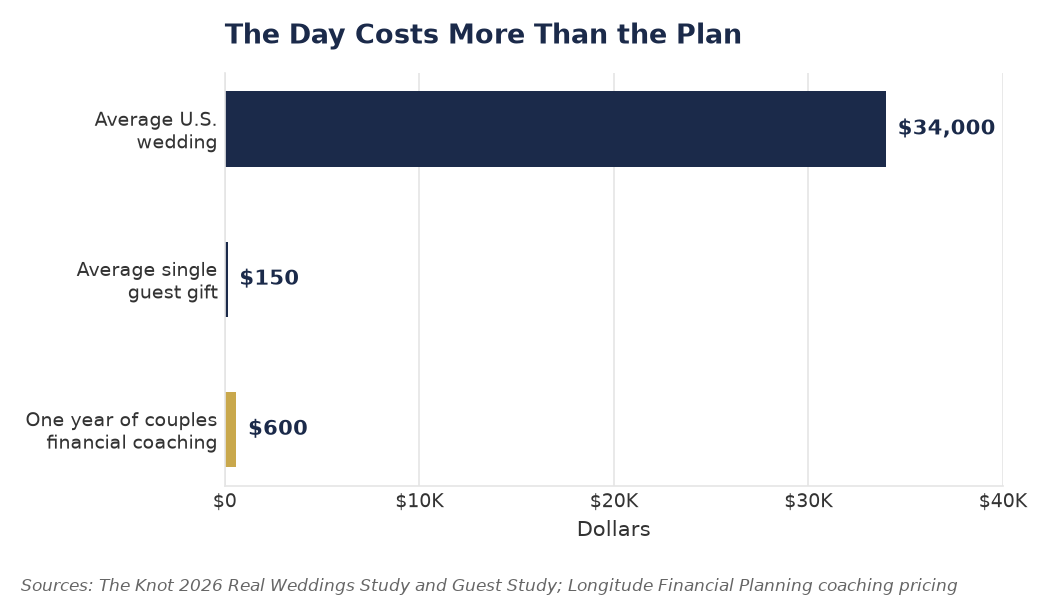
A single year of coaching for a couple costs less than four typical wedding gifts and a rounding error against the wedding itself.
The case for gifting it is not sentimental. Using dyadic data from 1,700 newlywed couples, researchers found that partners who saw their financial values as similar communicated better about money, and that communication predicted both marital satisfaction and marital stability (Family Relations). The downside case is just as documented. In a longitudinal study (my favorite) spanning more than 25 years, married women who reported arguing often about money were nearly three times more likely to divorce than those who argued rarely (Britt and Huston, 2012, via peer-reviewed review). A parent, a sibling, or a group of friends can fund the thing that most reliably shortens that argument. Loving couples make it easier for each other, and so do the people who love them.
How Gifted Planning Works
A gift with strings attached is not a gift. This one comes with none.
At Longitude Financial Planning we made it easy to give financial planning without concern over privacy or conflict of interest between parties.
The couple signs as the client. A third party is billed for the engagement. The agreement states plainly that the party paying is not the client, has no influence over the advice we give, and has no right to any information shared between the couple and the firm. A parent can pay for the plan and never see a number. That separation is important, because a financial advisor for newlyweds is useless if senior generations metal in the newlyweds financial life.
Paying for someone else's engagement is a gift, and the 2026 annual exclusion is $19,000 per recipient, or $38,000 from a married couple splitting gifts, so a funded planning engagement sits comfortably inside it with no gift tax return (IRS). Employers have a narrower version of the same idea: retirement planning advice provided to an employee and their spouse can be a tax-free fringe benefit, though the exclusion does not extend to tax preparation, accounting, legal, or brokerage services (26 U.S.C. 132, IRS Publication 15-B). Family funding covers more ground.
A blender lasts eight years. A beneficiary form filled out correctly in the first ninety days of a marriage can decide where several hundred thousand dollars goes forty years from now.
If you are engaged or recently married, financial planning for newly married couples is the one wedding item with a compounding return, and it does not have to come out of your own pocket. We will walk you through the first ninety days, run your return both ways before you file, and set up the accounts and beneficiary forms while everything is still easy to change. If a parent or family member has been asking what to get you, send them this and let us handle the rest.
Longitude Financial Planning is a fee-only registered investment adviser dedicated to fiduciary advice for the households we serve. This article is provided for educational purposes and reflects our perspective as of the date of publication; it is not personalized investment, tax, or legal advice. Tax laws, regulations, and market conditions change, and the strategies discussed may not be appropriate for every reader. We encourage you to consult a qualified professional, ideally one held to a fiduciary standard, before acting on any information here.
